
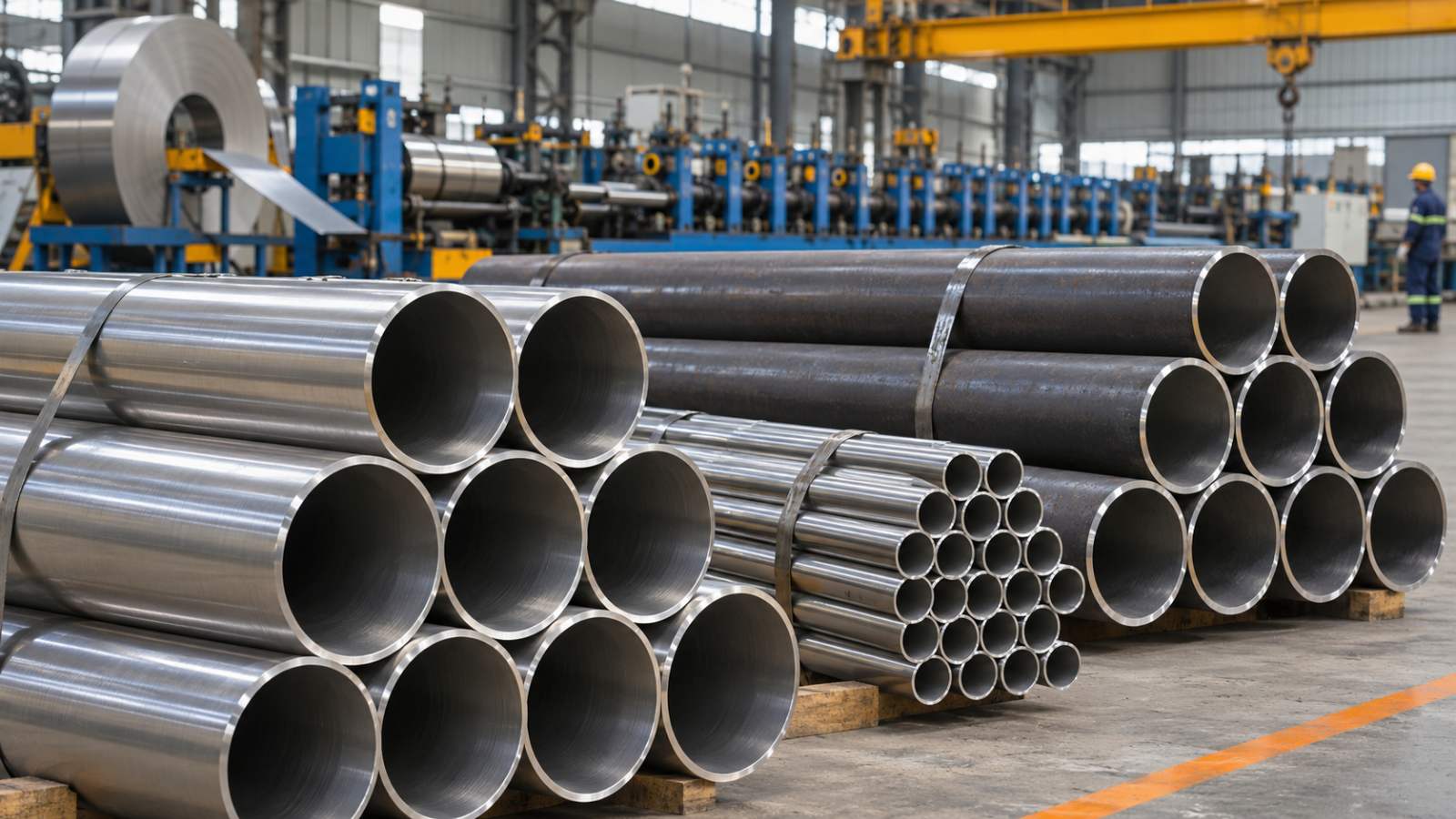
What Is ERW Pipe Yield and How Is It Calculated?
ERW pipe yield measures how much usable finished pipe is produced from the steel strip fed into a tube mill. To track ERW pipe yield accurately, manufacturers must record the input coil weight, measure losses at each production stage and compare the final accepted pipe weight against the original input.
A coil may enter the mill weighing several tonnes, but not every kilogram becomes a saleable pipe. End trimming, welding-related scrap, cutting losses, rejected lengths and finishing operations all affect the final output. Tracking these losses separately helps plant managers understand where material is consumed and where corrective action is needed.
The basic formula is:
ERW Pipe Yield (%) = (Accepted Finished Pipe Weight ÷ Input Strip Weight) × 100
For example, suppose a mill processes a slit coil weighing 10,000 kg and produces 9,620 kg of accepted finished pipes. The yield is 96.2%, while the remaining 380 kg represents material that did not become accepted output. This is a hypothetical example, not an industry benchmark.
However, knowing the overall yield percentage is only the starting point. The production team also needs to identify where those 380 kg went.
Where Does Material Loss Occur During ERW Pipe Manufacturing?
ERW pipe production involves several operations between slit coil loading and finished bundle preparation. Each operation can generate measurable scrap, rejected material or differences between expected and actual output.
For effective coil-to-pipe yield tracking, record material movement through the following stages.
1. Coil preparation and end trimming
Before entering the forming mill, the slit coil may require damaged-end removal, edge preparation or strip-end trimming. Strip sections removed during preparation reduce the material available for production.
If the plant uses an accumulator, material may also remain in the line when production stops or changes over to another size. Such material should be accounted for instead of being treated as an unexplained weight difference.
2. Forming and high-frequency welding
During forming, rollers progressively bend the steel strip into a tubular shape. The strip edges meet at the welding point, where high-frequency resistance welding joins them under pressure.
Welding commonly produces an external weld bead that is removed by scarfing. Depending on the process and product requirements, internal bead removal may also be performed. The removed bead contributes to process scrap.
Incorrect forming settings, welding defects or unstable mill conditions can also create rejected pipe lengths. These losses should be recorded separately from normal welding-related scrap.
3. Sizing, straightening and cutting
After welding, the pipe passes through sizing operations to achieve the required dimensions. The mill then cuts the continuously formed pipe into specified lengths using its cutting equipment.
Pipe-end trimming, sample cutting and off-length pieces can reduce accepted output. For example, a pipe ordered in six-metre lengths may generate short remnants that cannot be supplied under the original order.
Record these remnants by weight and reason rather than combining them with welding or forming losses.
4. Inspection, testing and rejection
Finished pipes undergo inspections and tests according to the applicable product specification and customer requirements. Dimensional deviations, weld defects, surface damage or failed tests may result in rejection or rework.
Not every rejected pipe becomes permanent scrap. Some lengths may be reworked or accepted for another permitted application after appropriate inspection and disposition.
Keep rejected, reworked, downgraded and scrapped quantities separate to avoid overstating permanent production loss.
5. Finishing and bundle preparation
Depending on the order, pipes may undergo end facing, beveling, additional finishing or other customer-specific operations. These activities can remove small amounts of material.
After final acceptance, pipes are counted, weighed where applicable and grouped into bundles. The accepted net pipe weight, excluding packing materials, should be the final figure used in the yield calculation.
How Can You Track ERW Pipe Yield by Coil, Size and Shift?
A single daily production figure cannot show which coil, pipe size or shift caused a loss. For meaningful analysis, each production record should connect input material with actual output, scrap and rejection quantities.
A practical tracking process includes:
- Identify the input coil: Record the slit coil identification, linked heat or lot, steel grade, thickness, width and actual input weight.
- Record the production order: Capture the pipe diameter, wall thickness, required length, grade and planned production quantity.
- Capture stage-wise losses: Weigh or otherwise determine end trimming, weld bead scrap, cutting remnants, rejected lengths and other material losses.
- Record accepted output: Capture the number of accepted pipes, bundle identification and net finished weight.
- Link production to the shift: Record the machine, production date, shift and responsible production team.
- Reconcile the material: Compare input weight with accepted output, recoverable material, scrap and remaining work-in-process.
For coil-wise analysis, calculate the yield of each consumed coil separately. If multiple coils are used in one production order, maintain their input and output allocation so the results remain traceable.
For size-wise analysis, group production records by pipe diameter, wall thickness and other relevant specifications. This allows managers to compare actual yields for the same product configuration across different orders.
For shift-wise analysis, compare production under equivalent operating conditions. Differences in product mix, coil quality, start-up activity and machine changeovers should be considered before attributing lower yield to a particular shift.
For manufacturers handling multiple pipe sizes and grades, a connected ERP system for tube and pipe manufacturing helps keep material, production and quality records together.
How Do You Compare Theoretical Pipe Weight With Actual Weight?
Theoretical pipe weight provides an expected material quantity based on pipe dimensions and an assumed steel density. Actual weight reflects the material measured through weighing or an approved production measurement method.
Both values are useful, but they answer different questions.
Calculating theoretical ERW pipe weight
For a round steel pipe, the theoretical weight per metre can be estimated using:
Weight (kg/m) = 0.02466 × Wall Thickness (mm) × [Outside Diameter (mm) − Wall Thickness (mm)]
This commonly used approximation assumes a steel density of approximately 7,850 kg/m³. It is a geometric calculation, not a measurement of actual mill output.
For example, consider a hypothetical ERW pipe with a 60.3 mm outside diameter and a 3.2 mm nominal wall thickness.
Theoretical weight = 0.02466 × 3.2 × (60.3 − 3.2) = approximately 4.51 kg per metre.
A six-metre pipe would therefore have a theoretical weight of approximately 27.04 kg. A bundle containing 100 such pipes would have an estimated theoretical net weight of approximately 2,704 kg.
Actual weight may differ because of manufacturing tolerances, dimensional variation and measurement conditions. The applicable product specification determines which dimensional variations are acceptable.
Why theoretical weight should not replace actual yield measurement
Theoretical weight helps production planners estimate material requirements and compare expected output against reported quantities. It does not identify the actual weight of weld bead scrap, rejected pipe lengths or cutting remnants.
For yield reconciliation, use a consistent actual-weight basis wherever reliable measurements are available. If output is estimated from dimensions and counts, clearly identify it as calculated weight rather than measured weight.
Linking production records with Formezy's Production module can support a common record of manufacturing quantities across the production process.
How Can You Reduce ERW Pipe Production Loss and Tube Mill Scrap?
Reducing ERW pipe production loss begins with identifying recurring causes rather than simply setting a lower scrap target. Each loss category should have a clear reason code and an assigned point of measurement.
Practical actions include:
- Review start-up scrap: Measure material lost during mill start-up, size changes and welding parameter adjustments.
- Monitor welding-related rejection: Separate weld defects from normal bead removal and investigate repeated rejection patterns.
- Improve cut-length control: Review off-length pieces, end trimming and cutting accuracy against customer requirements.
- Track coil-related variations: Compare defects and material losses against incoming coil identification, grade and relevant inspection findings.
- Check weighing accuracy: Use calibrated weighing equipment and consistent net-weight practices to reduce unexplained differences.
- Review rework separately: Measure recoverable output without treating every rejected length as permanent scrap.
Production and quality teams should review these measurements together. A loss recorded as a production issue may originate from incoming material, machine condition, process settings or inspection requirements.
The goal is a reliable material balance that helps teams act on repeatable causes instead of debating incomplete figures at the end of the month.
Common questions
What is the difference between ERW pipe yield and production efficiency?
ERW pipe yield measures the proportion of input material converted into accepted finished pipes. Production efficiency generally considers output relative to available operating time, equipment capacity or planned production, so a mill can achieve good material yield while operating below its planned production rate.
Should rejected ERW pipes be counted as scrap?
Not automatically. Rejected pipes should first be classified according to their approved disposition, such as rework, downgrade or permanent scrap, with only accepted finished material included in the yield numerator.
How often should a tube mill review coil-to-pipe yield?
Record material consumption, finished output and losses during production, then reconcile them at the end of each coil, production order or shift as appropriate. Weekly and monthly reviews can help identify recurring losses by pipe size, machine and material lot.
Formezy brings Production, Quality Control, Inventory, Weight Integration and other manufacturing modules onto one shared database. Heat numbers captured at goods receipt are carried through process stages, test results remain linked to the same lot, and scale or weighbridge readings can enter the system directly. AskEzy, Formezy's built-in AI, allows authorised users to ask questions about live ERP data and identify anomalies or trends within their role-based access. Manufacturers looking to connect material traceability with production records can book a Formezy ERP demonstration to discuss their tube mill workflow.